Friday, December 30, 2011

From the UCC Network: 12/30/2011 "Acting Out on the Airplane"


Acting Out on the Airplane

Mark 3:33-35

"Jesus responded, 'Who do you think are my mother and brothers?'  Looking around, taking in everyone seated around him, he said, 'Right here, right in front of you—my mother and my brothers.  Obedience is thicker than blood.  The person who obeys God's will is my brother and sister and mother.'"

Reflection by Lillian Daniel 

Even before the flight took off, we knew who would be offering our in-flight entertainment. The man in the seat in front of me began by taking out a ballpoint pen, putting it into his mouth and then taking a dramatic inhale. "You probably all think that I am smoking," he announced. "But I want to assure you that this is not a real cigarette, it is actually a sophisticated medical device that I use instead of smoking."

"That's not a medical device," his seatmate muttered to her friend.  "It's just a pen."

Well, that set him off.  For the rest of the flight he was ranting, turning around in his seat to beat in time to the music on his headrest, lecturing the invisible politicians he believed were accompanying him on the plane ride, and spilling strong drinks.

Finally a flight attendant came and sat next to him, calming him with a cup of water, gentle words, listening skills and the kind of thoughtful diplomacy that we could really use in Congress these days. 

At the end of the flight, two police officers put the inebriated man in a wheelchair and whisked him away. As a student of human nature (another word for "nosy") I followed them to see what happened, as did another man who began to ask questions of the police.

"Do you know this guy?" they finally asked him.

You could see the man hesitate for just a minute before saying, "Yes, I work with him. We're going to the same meeting."
"Can you look after him?" they asked.

Again, another long pause, and then, "Yes, I can help get him to the hotel." 

Jesus said that our family members are not just the ones we share a family tree with, but he never said it would always be tidy and reciprocal. Tomorrow that guy may not even remember who rescued him and took care of him the night before.

So I want to make a note in his family tree: On one sad night, a hard-working flight attendant and an exhausted work colleague both claimed him as a brother, whether he remembers it or not.

Prayer

Gracious and accepting Jesus, give me patience with the other members of your family, and the love to consider them my own family as well. And for all the times I have been the sister or brother no one wanted to claim, thank you for your patience with me. Amen.
[object Object]
About the Author
Lillian Daniel is the senior minister of the First Congregational Church, UCC, Glen Ellyn, Illinois. She is the author, with Martin Copenhaver, of This Odd and Wondrous Calling: the Public and Private Lives of Two Ministers.

Monday, December 26, 2011

From the UCC Network: 12/26/2011 "Leaning Toward the Future"


Leaning Toward the Future

Excerpt from Philippians 3:12-16

"This one thing I do: forgetting what lies behind and straining forward to what lies ahead."

Reflection by Martin B. Copenhaver

For many, this season is laced with nostalgia. We might glamorize the old days, perhaps being, in John Irving's phrase, "nostalgic for a time that never was." Or, it might be more like it was for my father, who, this time every year, would evidence the effects of a potent mixture of nostalgia and melancholy.

In either case, nostalgia is always suspect from a Christian point of view. That's because we affirm that the good old days--even when they really were good--are nothing compared to what God has in store for us. Even the triumphs and joys of the past will be surpassed by what is to come. That is the understanding that allows the Apostle Paul to testify:  "This one thing I do: forgetting what lies behind and straining forward to what lies ahead."

The Christian gospel, though rooted in history, is always forward-leaning. We lean like plants lean toward a window, even though they may never have seen the sun. We lean, with longing hearts, toward God's vision of the kingdom to come.

"Thy kingdom come," we pray. It is not here yet. That's why it is still a prayer. But, thank God, sometimes we are given a foretaste. And that is just what this season can offer sometimes--a blessed foretaste of what is to come.

Prayer

O God, help me to lean toward the future with expectant longing for what you have in store for me and for all creation. Amen.

Martin Copenhaver

About the Author
Martin B. Copenhaver is Senior Pastor, Wellesley Congregational Church, United Church of Christ, Wellesley, Massachusetts. He is the author, with Lillian Daniel, of This Odd and Wondrous Calling: the Public and Private Lives of Two Ministers

Saturday, December 24, 2011

From the UCC Network: 12/24/2011 "A Subversive Story"

A Subversive Story

December 24, 2011

 Luke 2: 1 - 14

"In those days a decree went out from Emperor Augustus that all the world should be registered . . . All went to their own towns to be registered. Joseph also went from the town of Nazareth in Galilee to Judea, to the city of David called Bethlehem . . . ."

Reflection by Anthony B. Robinson

We've finally arrived. In Bethlehem, at the manger. As Martin Copenhaver noted in the Introduction to this Advent booklet, it's the same story every year, the familiar story, nothing different.

There is comfort in that. Whether you gather in church this evening, or at home with family or friends, I hope you hear or read aloud this old, old story. “In those days, a decree went out from Emperor Augustus . . . .”

But don't let familiarity and its comforts deafen you to the subtle subversion this story would work in us and our world.

It begins with the acknowledgement of the great power of emperor and empire. Power to direct "the whole world" to be registered. Imagine that. Some power.

But when the camera focuses in, we see two people and a donkey. Joseph and his wife, Mary. In accordance with the Emperor's edict, they travel from Nazareth where they live and work, to Bethlehem, Joseph's ancestral home, where they are to register.

But what the Emperor doesn't know is that there is another power at work. Moreover, even he, the great Caesar Augustus, is serving, however unwittingly, this other power and purpose. God's hidden purpose is coming to pass. Ancient promises, made centuries before the current empire, are being brought to fulfillment, as Caesar's census brings David and Mary right where they are supposed to be.

So this familiar, comfortable and even beautiful story is something else. It is a subversive story. It tells us that the world's powers and empires are neither ultimate nor absolute. There is another power, God's power. There is another plan, God's plan, working its way to fulfillment in hidden and unexpected ways.

This familiar story makes a bold claim. Neither Caesar nor any other earthly powers are God. They are not final or ultimate. God alone is God. And this God rules and reigns in the oddest and most unexpected of ways. God reigns through a newborn baby who is born outside because there’s no room for him on the inside.

It's the same old story, shocking and new.

Prayer

Thank you, Lord, for this beautiful and familiar story. Grant us ears to hear its deep meanings and claims, its great unexpected subversive humor, and its wild hope, because, as you know, we really need it. Amen.


About the Author
Anthony B. Robinson, a United Church of Christ minister, is a speaker, teacher and writer. His newest book is Stewardship for Vital Congregations, published by The Pilgrim Press. Read his weekly reflections on the current lectionary texts atwww.anthonybrobinson.com/ by clicking on Weekly Reading.

Thursday, December 22, 2011

Giving in the Bleak of Midwinter [cross-post]

Giving in the Bleak of Midwinter


Written by Michael Purintun, M.Div.   
Monday, 19 December 2011 11:45

m-purintun-01-sWhat gift do you give when you are borrowing money just to make it through the month? What sort of happy holidays do you wish to children and adults, when you are worried about keeping the power on or whether you need to apply for food stamps?
With the echoes of “Baby, It’s Cold Outside” ringing in my ears, I find myself pondering the holidays and the season. It is cold and dark and can sometimes feel like the light has gone from the world. The season itself, though decorated with light and warmth in Hanukkah, Christmas, Kwanzaa, Solstice, and other “holy days,” is not without its downers. And we all know them.
On the radio, you can listen to some Country singer wail on about “The Christmas Shoes.” There are a plentitude of Holiday specials and Lifetime movies encouraging people to just feel the spirit. And you can watch A Christmas Carol, and wonder about how you could be so miserly as Scrooge, or feel like you are living Bob Cratchet’s Christmas (possibly even worse). Many of these events and movies, and even the commercials in between assume an ability to change the world for the better by just being more generous. What if you can’t be more generous?
What do you give when you don’t have enough?
What do you give (emotionally) when the world has ground you into dust, and just getting up in the morning is an accomplishment?
That sense of barrenness or bleakness reminds me of the hymn, “In the Bleak Midwinter,” the text coming from a poem by Christina Rosetti. The first stanza in particular:
In the bleak midwinter
frosty wind made moan,
Earth stood hard as iron, 
water like a stone,
Snow had fallen, snow on snow,
Snow on snow,
In the bleak midwinter,
long ago.
It is not just the earth that is sometimes hard as iron. Sometimes life itself is hard. Sometimes we can feel broken by the circumstances of life. I know I can.
I was reminded of that recently when someone remarked that they had presented a seminar recently on the unemployed, and how to work with them. My heart dropped as I realized that I was part of that group. I could teach that seminar from real life experience! My life over the past three years has been, at times, terribly hard. Most months I worried how I was going to make my mortgage, or the condo payment.
Presently, I work part-time for the Wayne Oates Institute, and do some other part-time work. I also get some help from family and friends. Working at the Oates Institute has been a great new experience in my life, but I am still under water, almost three years after being let go.
Baby, it really IS cold outside. When a politician talks about the unemployed as if they are lazy dogs that just don’t work hard enough, like them or the Wall Street Bankers, it hurts. For example, in today’s New York Times, I read that Mitt Romney is quoted as saying that:
… the American people, edified by American principles, will rise to the occasion again, securing our safety, our prosperity and our peace.
One of these principles is a merit-based society. In a merit-based society, people achieve success and rewards through hard work, education, risk taking and even a little luck.
My colleagues in unemployment and underemployed, are hard-working, educated, and talented people. They frequently have a wide range of skills. One man I know is working as bus-driver in the early morning, a testing grader during the day, and UPS shipping clerk at night. Another is a young woman six months pregnant with her first child that struggles to find work. She shares her home with her boyfriend, and other unemployed and underemployed family members because there is not enough room at her mother’s house. Then there are the people who have just given up on careers, and have settled for jobs that are basic … many offering no health care at all.
This does not jive with the common perception in our society that it is always possible to work out of a bad situation. Or that “God never hands you more than you can handle.” I’ve seen and met people who had more than they could handle, or who were broken. They DO exist. And how do we respond?
I think we have to realize two things that are related: first that we are never alone. There are others who also walk these barren landscapes, and they also are searching for hope. But the greatest source of hope is not to be found out there, but within and among the community. Hope, warmth for the cold, and nurture for those needing it can be found as we realize that while the earth may be cold and hard, it can be warmed by the kindnesses of friends, family, and strangers. Hope is, however, not just in the actions of others, but in our own openness to it. As we allow ourselves to be warm, vulnerable, and human, we open our own hearts. And we warm ourselves and the world around us. Back to Rosetti:
What can I give Him,
Poor as I am?
If I were a shepherd
I would bring a lamb,
If I were a wise man
I would do my part,
Yet what I can I give Him,
Give my heart.
Admittedly, a very Christian sentiment, but the meaning is transcendent in that all we can ever offer to one another and the world is our heart. It is, truly, the greatest gift we can give this holiday season. Whether we sing about lighting a candle for the Maccabees, or about celebrating solstice, or Christmas, we need to face the reality that the offering that is the most meaningful is that of ourselves.
May each of us find the courage to open ourselves and to be vulnerable to the other during this season, and throughout the year.


From the UCC Network: 12/22/2011 "How Can I Keep From Singing?"


"How Can I Keep From Singing?"

Psalm 89 

"I will sing of your steadfast love, O Lord, forever."

Reflection by Talitha J. Arnold
"My life flows on in endless song," affirms an old hymn, "above earth's lamentation. . . .
I hear the real, though far-off hymn that hails a new creation.
Through all the tumult and the strife, I hear the music ringing;
It sounds an echo in my soul—how can I keep from singing?
 - Gelineau
"The Christian faith was born singing," Joseph Gelineau wrote, "and it has never ceased to sing." That is never more true than in Advent. When pregnant old Elizabeth greeted her pregnant young cousin Mary, she threw back her head and sang, "My soul magnifies the Lord, and my spirit rejoices in God my Savior." When the angel announced to the shepherds the birth of that child, a heavenly chorus joined in on "Glory to God!" Our carols, from "Joy to the World" to "Good Christian Folk, Rejoice!" echo those songs of joy. 

But as Psalm 89 reminds us, we are called to sing of God's steadfast love forever- --in good times and hard.  So with our joy, we also sing our longing, "O Come, O Come Emmanuel," and our wondering "What Child is This?"

Like the Psalmist, we sing our faith in the One whose love is steadfast, in every season, every time, every joy, every sorrow. The One born "in the bleak midwinter long ago." Born into the "hopes and fears of all the years." "Born today"—and every day.

How indeed can we keep from singing? 

Prayer

In this season and every season, O God, help us to sing your steadfast love forever. Amen.
arnold-talitha-79.gifAbout the Author
Talitha J. Arnold is the Pastor of the United Church of Santa Fe, New Mexico.


Wednesday, December 21, 2011

From the UCC Network: 12/21/2012 "Interruptions"


Interruptions

Luke 1:46-47

"And Mary said, 'My soul magnifies the Lord, and my spirit rejoices in God my Savior.'" 

Reflection by Martin B. Copenhaver

For the most part, I don't like interruptions.  I would rather plan my day and plan my life.  So usually I begin the day by surveying all the things I want to accomplish and hope no interruption will prevent me from doing so.

I say that as a confession, because interruptions are one of God's preferred modes of confronting us.  The word interruption means, literally, "something that breaks in between."  We may experience interruptions as our routine breaking up, when it may be that God is trying to break in to our lives.

In the Christmas story, it is remarkable how the characters respond to having their lives interrupted.  For instance, Mary's plans to marry are interrupted by an angel who tells her that she is about give birth to the Son of the Most High, even though she is little more than a child herself.  How does she respond to this interruption of her plans?  She sings a song of praise.

The very birth the angel proclaims is itself an interruption.  It is God interrupting God's own routine by coming as a little one, born in a forgotten corner of a big world.  And when God chooses to come as close to human life as breath and bone and muscle, we can’t look at our own lives in the same way again.

It's not a story we would have come up with ourselves.  It's nothing we would have planned.  In a way, it's an interruption.  But in this season, for once perhaps, we have a chance to put our plans aside long enough to greet an interruption as welcome.  After all, it could be God breaking in.

Prayer

God, don't listen to me when I ask not to be interrupted.  Break in.  Break in.
Martin Copenhaver

About the Author
Martin B. Copenhaver is Senior Pastor, Wellesley Congregational Church, United Church of Christ, Wellesley, Massachusetts. He is the author, with Lillian Daniel, of This Odd and Wondrous Calling: the Public and Private Lives of Two Ministers

Saturday, December 10, 2011

From the UCC Network: 12/10/2011 "The Prophets of Advent – Cost and Joy"


The Prophets of Advent – Cost and Joy

Isaiah 53: 1-5 (KJV) 

"He is despised and rejected of men; a man of sorrows, and acquainted with grief: and we hid as it were our faces from him; he was despised, and we esteemed him not.  Surely he hath borne our griefs, and carried our sorrows: yet we did esteem him stricken, smitten of God, and afflicted.  But he was wounded for our transgressions, he was bruised for our iniquities."  

Reflection by Kenneth L. Samuel

We should never assume that our celebrations of the advent of God in Christ Jesus will attract and appeal to everyone.  Isaiah's prophesy about the life and sufferings of Jesus are enough to prompt the question: Is anybody really willing to celebrate and to follow a messiah of sorrows, who was acquainted with grief?

The advent of Jesus is not just about his manger; it is also about his mission.  A mission that would render him stricken, smitten of God and rejected by men and women.  Where is the merriment in that?  Those of us who celebrate not just the manger but the mission of Jesus are aware of this poignant paradox.

Yet, still we joyfully celebrate the coming of our Christ, for we understand what Isaiah understood: suffering for the cause of God's realm is redemptive in every sphere of life.  In fact, the suffering of Jesus is not ancillary but integral to our celebration of Advent. 

Prayer

Lord, during this Advent season, let our celebrations and actions reveal to us afresh the redemptive power that only comes through our sacrifices for others. Amen.
[object Object]
About the Author
Kenneth L. Samuel is Pastor of Victory for the World Church, Stone Mountain, Georgia.

Friday, December 9, 2011

From the UCC Network: 12/09/2011 "In the Ups and Downs, God Levels Things Out"


In the Ups and Downs, God Levels Things Out

Isaiah 40:3-4

"A voice cries out: 'In the wilderness prepare the way of the Lord, make straight in the desert a highway for our God. Every valley shall be lifted up, and every mountain and hill be made low; the uneven ground shall become level, and the rough places a plain.'"  

Reflection by Lillian Daniel

People who are facing a serious illness tell me they have a new respect for how changeable life is. Suddenly, they realize how precious the ordinary moments are. One man once told me what many others have said in different words: "I used to complain about being bored. But I could use a little boring right now."

These words from Isaiah seem to predict the divine future God wants for us. God does not want us laboring up steep mountains one minute and down in a ditch the next minute. God wants to level things out.

But life on earth doesn't work that way. Life delivers wild fluctuations in the stock market, our love lives, our health and even our sanity. The ground we travel is uneven and rough.

It is God's grace, working through the passage of time, which evens out the terrain. We look back in hindsight and don't just see a lot of ups and downs. As we learn from our mistakes and our heartbreaks, some of those past mountains get laid low.

It's good preparation for the real moment of understanding, when we meet Jesus in the afterlife and finally understand that all this was just the prelude. Until then, let’s hold on to the image of God watching us in our ups and downs, and using grace and mercy to turn the rough places into a fertile plain.

Prayer

When my heart is a desert, make straight a highway through me, and remind me that one day every mountain I am climbing will be made low and every valley will be lifted up. Eventually. Amen.
[object Object]
About the Author
Lillian Daniel is the senior minister of the First Congregational Church, UCC, Glen Ellyn, Illinois. She is the author, with Martin Copenhaver, of This Odd and Wondrous Calling: the Public and Private Lives of Two Ministers.


Wednesday, December 7, 2011

Unemployed Workers Need Compassion from Congress [cross-post]

Unemployed Workers Need Compassion from Congress

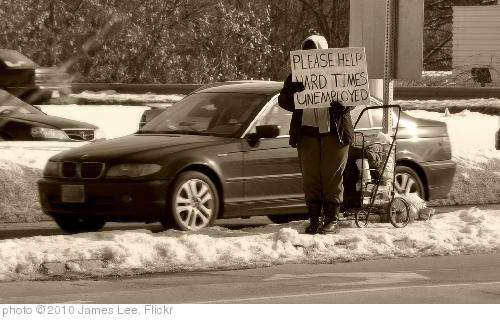
'Unemployed' photo (c) 2010, James Lee - license: http://creativecommons.org/licenses/by/2.0/

I recently read an unsettling New York Times article that sheds light on just how many people are still struggling in this poor economy. 

According to a study cited by the Times, of all the people who lost their jobs after the financial crisis, only 7 percent have managed to return to their previous financial position. This is no surprise to the millions of families who continue to struggle, but for many on Capitol Hill this data should serve as a sobering call to action on behalf of those struggling families. Winter is coming, and unemployed families in need of shelter and heat could be left out in the cold.

While economists say that we’re out of the recession, most Americans clearly aren’t experiencing a recovery. The unemployment numbers released last week were positive, but also show that we’re not creating enough jobs to return us to full employment before 2027. For every four unemployed workers, there’s only about one job opening. We need more jobs, but these numbers also remind us that unemployed workers will continue to struggle for some time.

Many of these workers rely on unemployment insurance for basic necessities. The National Employment Law Project explores the benefits of unemployment insurance in this briefing paper, which states that 3.2 million people, including 1 million children, would have slipped into poverty without unemployment insurance last year. Research also shows that people receiving unemployment insurance are more likely to keep looking for a job. Recipients can worry less about where their next meal might come from and focus more on finding a job.

Unfortunately, Congress’ focus on deficit reduction has delayed consideration of extending long-term unemployment insurance benefits. These benefits will expire at the end of the year unless Congress acts. As the Times article discusses, those who have been unemployed the longest often have the most trouble finding a new job. Now, 6 million people stand to lose their benefits in 2012. This sudden cut-off from a critical source of income will have devastating effects for families who rely on it to pay their rent and put food on the table.

No previous Congress has cut off unemployment benefits when the jobless rate was above 7 percent. Congress must focus both on creating jobs and forming a circle of protection around those who do not have one. To do otherwise would leave millions of families out in the cold.


Ben-d'avanzoBen D'Avanzo is Mimi Meehan Fellow at Bread for the World.


From the UCC Network: 12/07/2011 "Can You Hear Me Now?"


 "Can You Hear Me Now?"

Hebrews 1:1

"Long ago God spoke to our ancestors in many and various ways by the prophets, but in these last days God has spoken to us by a Son, whom God appointed heir of all things, through whom God also created the worlds." 

Reflection by Kenneth L. Samuel

How many times have we abandoned all efforts to communicate with persons who were non-responsive?  After a few unanswered messages or e-mails we've had it! 

After all, who would even want to communicate with someone who obviously doesn't want to talk and couldn't care less about building any kind of mutual relationship?  What kind of person would keep reaching out and trying to establish dialogue with people who are obviously not interested?  That kind of person would be God. 

Our whole history is a chronicle of God’s patient and persistent attempts to open up a divine—human dialogue with those of us who isolate and insulate ourselves by talking only among ourselves.  The advent of every prophet was an invitation for us to dialogue with God; the rejection of every prophet was a refusal of that invitation. 

And just when we thought God might have abandoned the effort, God, instead, turned up the volume, wrapped the message up in human flesh and spoke to us in the living language of sacrificial love personified in Jesus.  Can we hear God now?

Prayer

Lord, after all of our dismissals and rejections of your call, thank you for never giving up on us.  You have spoken clearly to us through your Son and we hear you now.  Amen.
[object Object]
About the Author
Kenneth L. Samuel is Pastor of Victory for the World Church, Stone Mountain, Georgia.

Tuesday, December 6, 2011

From the UCC Network: 12/06/2011 "Unclean"


Unclean

Acts 11:5-9

"I saw a vision. There was something like a large sheet coming down from heaven, being lowered by its four corners; and it came close to me. As I looked at it closely I saw four-footed animals, beasts of prey, reptiles, and birds of the air. I also heard a voice saying to me, 'Get up, Peter; kill and eat.'  But I replied, 'By no means, Lord; for nothing profane or unclean has ever entered my mouth.'  But a second time the voice answered from heaven, 'What God has made clean, you must not call profane.'" 

Reflection by Quinn G. Caldwell

Ministers spend a lot of time struggling against the culture's frenetic, consumerist interpretation of Christmas.

Which is needed. But I wonder whether we go too far, like the Puritans who forbade the celebration of Christmas altogether because of its roots in paganism. I mean, if God can make unclean animals clean for Peter to eat, can’t God find a way to turn a pagan holiday into a Christian one?  And mightn't God even be powerful enough to co-opt the culture's co-optation of the day of his birth?

In that Spirit, here are some Christmas things that, while they may have nothing to do with the birth of Christ, I believe God approves of anyway:
•    Elvis' Christmas Album. If it can make my whole family sing together while performing a complex operation involving a saw, a tree, a small living room, electricity, and water without killing each other, it's holy.
•    Shopping. Can get out of hand, but searching for a great gift to make someone happy can be a profound experience.
•    Christmas cards. Likewise with the out of hand, but they help people keep in touch and help the lonely feel connected.
•    How the Grinch Stole Christmas. In fact, Christmas specials in general—especially if they're commercial-free.
•    Your favorite. Bring it on in the comments on Facebook!
Prayer

God, you can make anything holy. Bless my celebrations when they increase my love, make me generous, or open me to your world. If they do the opposite, make them go the way of last year's fruitcake. Amen.
nullAbout the Author
Quinn G. Caldwell is Associate Minister of Old South Church in Boston, Massachusetts, and co-editor, with Curtis J. Preston, of the Unofficial Handbook of the United Church of Christ published by The Pilgrim Press.

Monday, December 5, 2011

From the UCC Network: 12/05/2011 "Look Up, I Can Help"


Look Up, I Can Help

Psalm 27: 14

"Hope in the Lord! Be strong! Let your heart take courage! Hope in the Lord!" 

Reflection by Anthony B. Robinson

A friend shared this story about her mother who was a choir director and music teacher for her entire professional life.

If there came a time in a performance when things started to go awry--the accompanist was off-beat, or the sections were drifting from each other--the natural reaction of choir members was to hunker down, to concentrate really hard, each on his or her own music.

Usually this made things worse, as each person focused so intently on their own part they forgot to look up. "Mom," my friend said, "wanted to yell over the music, 'JUST LOOK UP! I CAN HELP!' But in the middle of the piece she just had to trust that the choir members would eventually lift their gazes of their own accord."

When things start to go awry in our own lives, we too are likely as not to hunker down. We do what we have been doing only harder. We focus on ourselves and forget to LOOK UP to see what is important, to regain perspective, to find guidance and strength in God.

Psalm 27 is the prayer of a person with a few things awry in their life and world. And it is a multiple-exclamation-point-reminder to LOOK UP!!! Lift your eyes, lift your heart to the Lord. Let your heart take courage. Be strong. Look up and then put all your trust down on God.

Prayer

So often, Holy One, I imagine it is all and only about me and my doing. Whether you are over my head or beneath my feet, I forget to look to you, to trust in you. Thank you for this ancient reminder that I can place my trust in you today. Amen.
Anthony B. Robinson Nov 2011
About the Author
Anthony B. Robinson, a United Church of Christ minister, is a speaker, teacher and writer. His newest book is Stewardship for Vital Congregations, published by The Pilgrim Press. Read his weekly reflections on the current lectionary texts at www.anthonybrobinson.com/ by clicking on Weekly Reading.

Sunday, December 4, 2011

Is Christmas Outdated? [cross-post]

IS CHRISTMAS OUTDATED?


Now, there’s an impertinent question. But realistically, with commercialism now dominant in our cultural environment, that has to be asked of our Christian Advent and Christmas celebrations and worship.
Here’s what commercial preparations for Christmas are like this year where I live: Sears’ Wish Book catalogue arrived in July. Christmas decorations went up soon as Hallowe’en was over. Advertising and sales started at the same time. Black Friday madness spread to Canada the day after American Thanksgiving trying to keep Canadians at home for their Christmas shopping. And so on … and on … and on ….
It isn't as simple to fix as suggested by the once popular slogan, “Put Christ Back into Christmas.” Many who attend our Christmas Eve service doubt the whole story, but cannot bring themselves to admit it. Do their childhood  memories still haunt them?
Nor are the traditional “Christmas Pageants” sufficient to dispell the ghosts of Christmases past. Everyone expects the same drill telling the now familiar composite story: The Babe born in a manger in Bethlehem while angels sang overhead. Shepherds hastening from their pastures and three wise men arriving from the east carrying symbolic gifts.
Or was it that way? The narratives in Matthew’s and Luke’s Gospels cannot be pushed together without doing violence to both.
Of course, biblical scholars have long raised serious doubts about the whole legend of the Nativity. It is story but not history, they say. Two of the four Gospels, Mark and John, make no mention of it. In one of his letters written a decade or more before the earliest Gospel of Mark was composed, the Apostle Paul didn't say anything except that Jesus “was born of woman” and “born under the law.” Paul knew Jesus’ brother, James, but said nothing more about his parents. He seems to have assumed that the birth was perfectly natural for any human being then or now.
Progressive views have tried to turn the Christmas story from doctrine to reality. Geza Vermes has written one ofthe best studies of the event in his The Nativity: History and Legend. (London, Penguin 2006). He presents the “virgin” birth as a totally human event in the life of the Mary. He suggests that she may have been a child bride who had not yet begun her menstrual cycles. So she was still a virgin in terms of Judaism of that day.
John Shelby Spong states unequivocally in his latest book, Re-ClaimingThe Bible In A Non-Religious World (HarperCollins and HarperOne2011): “While no reputable scholar today thinks of these stories as literal history, we do find some historical links in the stories that we can use for dating purposes.” He cites King Herod’s death as recorded in 4 BCE, so Jesus must have been born before that for his birth to have been historical. Contrary to his usual counsel against literalism, is that his attempt to make it historyHe doesn't mention that it was Saint Dionysius the Small who established the year 1 as Anno Domini. That wasn't until 625 AD/CE.
For several hundred years after the Christian faith tradition began its spread from Palestine to Rome and beyond, the Church did not mark Christmas at all. It wasn't an important feast on the Christian calendar. Now, like any other religious holiday in the present secular and multicultural age, it is becoming less and less important for most people.
The local congregation where I worship is waiting to see if the traditional three Christmas Eve service will be well attended this year. An online discussion about the beginning of Advent raised serious concerns about the discouraging downer of the scriptures read during the four Sundays of Advent before Christmas.
The question for all Christian churches is whether we change our liturgical celebrations of Advent and Christmas to match the advances of modern biblical scholarship or match the massive impact of commercialism.
And yet ….. A colleague writing the back page article in The United Church Observerfor December 2011 has told us to “stop looking for theological loopholes and simply rejoice in the mind-exploding miracle of the birth of God in the very human child of Bethlehem.”
Isn't that what Christmas is about?


-30-

At The Corner of Injustice, Exploitation and Corruption [cross-post]

At The Corner of Injustice, Exploitation and Corruption


Growing up as a product of the system as well as working in the inner city, I experienced and witnessed many things that disturbed and angered me. Things such as injustice, inequality, predatory lending, exploitation, ignorance, negligence and corruption. The disparity between the poor and the wealthy is painfully obvious. Here in Indianapolis, all you have to do is just stand on the corner of any major intersection and do a 360 degree turn to see the difference.

In the inner city, you will see a liquor store, pawn shop, Rent-A-Center, Check Cashing/Pay day loan store, fast food, Buy-Here, Pay Here Lot and a Bus Stop. Rarely, will you see a grocery store or park within walking distance. Go just a mile north, if you do a 360 turn, you will see a grocery store with fresh produce, a bank, a library, a park for the walkers, kids and even the dogs. Yes. Sadly, the pets have more opportunities for food, grooming and recreation in the suburbs than the people in the inner city.

If you just look down on the banks of White River, you will see “tent cities” of the local homeless assembled together. Go 3 miles west, then you will find yourself in a 2 mile radius of mobile home parks that house thousands of impoverished familes all living far below the poverty line. Then, drive 5 miles east, you will see a once vibrant and thriving farm, in decay and in ruins. New legislature has made farming more complex and costly due to new licensing fees and laws so the farmers who have been left with their ancestors way of life, have lost their legacy and contribution to the world to foreclosure.

The contrast in the environment, atmosphere, support and opportunities are astounding. If you have a group that is already disadvantaged based on social-economic conditions, throw in the lack of educational opportunities, logic will tell you that the odds against one group v/s the other group will be very uneven. Does this make success impossible for the underserved? No. But, logic will also tell you that, the higher the odds placed against someone, the higher the causalities in statistics.

Witnessing this first hand made me question democracy in our country. Was there really equal opportunity? I was so curious that when I was in my mid-twenties, I started reading and studying politics. It became an obsession. I had a goal in mind. To work my way up the political ladder and run for congress by my mid 30’s so that I could actually make some changes.

Of course this was before I was saved. When I gave my life to Christ, I still studied politics, but then quickly realized that I was now studying it with a new set of eyes. It’s like I got a pair of new glasses. My compassion became more passionate as I now felt sympathy for yes, even the wealthy. I saw politics as a battle of power and monopoly and to see people resort to tactics of manipulation under pressure was devastating. The ones who got the most votes were the ones who became the most creative in their manipulation. So if the people’s best interest was not their motivating factor, all they had to learn to do was to L-I-E.

Faith and Politics is like BP Oil and the Gulf. They don’t mix. When the BP oil explosion occurred, it turned God’s beautiful body of water that displayed the beauty of the circle of life into to a cesspool. Life became death, fish could not swim, birds could not fly and the tides were washing in corpses. This is the same result we get when we try to throw God in with Politics.

Let’s compare the key differences of faith and politics. When I say faith, I mean the faith that this country proudly proclaims -Christianity.

• MONEY – The love of money in scripture is “the root of all evil” (1 Timothy 6:10) and can corrupt the most noble of men, but in politics, it is necessary as well as the ripe fruit hanging from the tree that has people salivating with lust and stepping on the hands of those who are in their way. If you follow the money, you will often find the seed of much of humanities sorrows.

• POWER – Jesus tells us if you want to become the greatest, you should become the least. (Matthew 19:30) Politics tells us the MAJORITY wins and that image is everything. One thing that is certain about politics is that there is a lot of discord, dissension, back-biting and false promises. That is not of God. Candidates quickly learned that the best way to win the vote of a citizen is to cater to their “faith.” Faith quickly became a tool to manipulate the American voter and soon the American Flag started replacing the cross in many American towns. When flags replace the cross, than war becomes something to celebrate over something that should be a last resort.

• WAR- In Christianity, war was justified as a means to protect and defend your people and your land and to restore peace. In politics,war is often for economic resuscitation, capitalism, occupation and domination. The soldiers fighting often come from the towns, homes and families of the POOR. Due to a lack of education and job opportunities, the military is often used as dangling carrot for a paid education, health care and a steady income. (Luke 3:14)

• CLASS – In the Kingdom of Heaven, there will be no liberals v/s conservatives, rich v/s poor, black v/s white…Every Tribe. Every Tongue. Every Nation, Every Knee will bow down and proclaim Christ is Lord. (Romans 14:11) The kingdom will have no room for racism, politics, capitalism, battle of the sexes and there will be no “Coach” and “First Class” rides. (James 2:6)  If you find yourself in a toll booth pulling a lever that votes against a hungry child or senior citizen “deserving” a free meal, health care and education because it may comes from the pockets of the wealthy, then you have made your choice. (Matthew 19:21)

• EQUALITY – Jesus repeatedly reached out to those at the bottom of the social pyramid–poor people, women, Samaritans, lepers, children, prostitutes and tax collectors. (Luke 4:18-19) Jesus was also reaching out to accept people who were well-placed, but he made clear that all, regardless of social position, needed to repent. He knew that oppression can be under the chains of poverty or under the chains of riches. (Matthew 19:16-30, Luke 18:18-30, Mark 10:17-31) For this reason, he invited the rich young man to sell all of his possessions and give the proceeds to the poor. Lastly, when Jesus walked over the hill overlooking the desolate in Jerusalem, He wept as he had compassion for them.  He not only saw all in their physical oppression but he also saw their hearts.  Did he stop to think if they deserved His compassion? No. We were ALL born and shaped in iniquity. Do you feel the same compassion for the poor as you drive through the inner city and the rural towns? Do you feel sympathy for the wealthy, who are numb to the impoverished trapped in a false identity worshiping a false God? (money) Or do you find yourself judging them? If you lack compassion and love for Gods people, then you gain nothing, no matter how many possessions or how much power you may have (1 Corinth 13)

Politics and our walk of faith are in total opposition of one another. If you are liberal, you may lack compassion for the wealthy. If you are conservative, you may lack compassion for the less fortunate. When I found out that running for political office would be to often compromise the very fabric of my faith, I let that idea go.

A living example in history aside of Christ was Dr. Martin Luther King Jr. He did not allow any political affiliation outshine whom He was really speaking for. When we compare Dr. MLK Jr. to a political power horse, we are really doing a disservice. He led the country through a very hard time based on truth not lies. He was a man that was willing to die (and did) than to compromise. He never sold the American Dream, but he proclaimed that we each had the ability and power within, to bring God’s will (peace with all men) on earth as it is in Heaven. (Matthew 6:9-10) He exemplified how to discern the difference between politics and faith.

What are the repercussions of mixing the two? Let’s look at the state of our country today. We have allowed politics and greed to literally bankrupt the american people and the globe as a whole. What is coming next is going to be hard to fathom to those who have been blinded. When we allow politics to dilute the liberating message of gospel, then we have the same result as the BP oil spoil- a cesspool.

—-
Katrina is an author, columnist, and founder of Butterfly Ministries Inc. for broken women and girls in Indianapolis, Indiana. She also facilitates workshops in the inner city on financial literacy, goal planning and job development. Her focus is on faith, family, social justice, advocacy and the power of community. She is the author of the newly released book “The Butterfly Movement” and upcoming book “Wisdom is a She” due to release in the summer of 2012.

Friday, December 2, 2011

If Jesus Came to My House [cross-post]


If Jesus Came to My House: An Advent Reflection

111201-jesushomePhoto by Flickr user  Christian Haugen
[Editors' note: This Advent season, we will be running a series of reflections on the Bread Blog from members of New York Avenue Presbyterian Church in Washington, DC. The lectionary readings for this post are Isaiah 3:8-15;  Matthew 25:31-46; 2 Peter 3:8-18. Keep reading the Bread Blog for more Advent reflections each day.]


While reading the verses for this day of Advent, I recalled a book I enjoyed as a child entitled, If Jesus Came to My House, by Joan Gale Thomas. Originally published in England in 1951, my parents bought this little book in 1956 with its black, white, and red illustrations to read to my younger brother and sister, and me.

In the book, a little boy imagines what he would do “if Jesus came to his house." The boy images that he would  treat Jesus as an honored guest, offering him the best seat by the fire, serving him tea, showing him favorite spots in the house and the garden, and playing with the boy’s  favorite -- and nicest -- toys. The boy would not let Jesus leave without inviting him to choose the best of these playthings for himself. The book reads:

And then He’d smile and wave goodbye,
and so would end our day—
but all the house would seem to smile
because He’d been our way.

The boy then acknowledges that Jesus can never call on him in the way that he has imagined. He is quickly consoled, however, saying that he can go to Jesus’s house and “sing and worship him and talk with him in there.” And something more -- the tale’s punch line: The boy can invite others into his home, his life; he can reach out to and help them.

And I can make Him welcome
as He Himself has said,
by doing all I would for Him
for other folk instead.

Joan Gale Thomas has taken Matthew 25 and made this powerful scripture accessible to a child -- to all of us children of God:

Then the king will say to those at his right hand, “Come, you that are blessed by my Father, inherit the kingdom prepared for you from the foundation of the world; for I was hungry and you gave me food, I was thirsty and you gave me something to drink, I was a stranger and you welcomed me, I was naked and you gave me clothing, I was sick and you took care of me, I was in prison and you visited me.” Then the righteous will answer him, “Lord, when was it that we saw you hungry and gave you food, or thirsty and gave you something to drink? And when was it that we saw you a stranger and welcomed you, or naked and gave you clothing? And when was it that we saw you sick or in prison and visited you?” And the king will answer them, “Truly I tell you, just as you did it to one of the least of these who are members of my family, you did it to me.”

Where the child’s story leaves off, the scripture continues, detailing the consequences of failing to care for others:

Then he will say to those at his left hand, “You that are accursed, depart from me into the eternal fire prepared for the devil and his angels; for I was hungry and you gave me no food, I was thirsty and you gave me nothing to drink, I was a stranger and you did not welcome me, naked and you did not give me clothing, sick and in prison and you did not visit me.” Then they also will answer, “Lord, when was it that we saw you hungry or thirsty or a stranger or naked or sick or in prison, and did not take care of you?” Then he will answer them, “Truly I tell you, just as you did not do it to one of the least of these, you did not do it to me.” And these will go away into eternal punishment, but the righteous into eternal life.’


Prayer: Oh, God, we wait for the birth of your son, and with Peter "for new heavens and a new earth, where righteousness is at home." May we treat others as we would treat you. Thank you, dear Lord, for your abiding patience with us. And when your kingdom comes, "may you find us at peace, without spot or blemish." Amen


Edith Holmes Snyde is a member at New York Avenue Presbyterian Church in Washington, DC. Visit their website at www.nyapc.org.


From the UCC Network: 12/02/2011 "Much More than Words"


Much More than Words

1 Thessalonians 1:5 

"For our gospel came not unto you in word only, but also in power, and in the Holy Ghost, and in much assurance . . .”  

Reflection by Kenneth L. Samuel

As we approach the celebration of the incarnation of God in Christ at Christmas, our ears are already filled with the festive, majestic words of the season. "Shalom," "Glad tidings to all," "Peace on earth," "Wise men still seek him," "The greatest gift of all," "For unto us a son is born; a child is given," "Silent night, Holy night," "Behold the star," "Joy to the world!"

But despite the beloved choruses of our holiday hymns, scriptures and salutations, the Apostle Paul suggests that what God has given to us through Christ Jesus can never be adequately proclaimed through words alone. For in Christ, God has given us much more than a good word or a good sentiment or a good idea. In Christ, God has given us the power of word made flesh. In Christ, God shows us the awesome power we have when we take lofty principles and incorporate them into everyday human practices. In Christ, the concept of good is realized and personified in a human character to which we can all relate. In Christ, God invites us to simultaneously embrace the full humanity and the full divinity that is in each of us.

Such Good News can never be conveyed in words alone. This Good News requires a passionate presence among people, the strength to forgive and the humility to be forgiven, the faith to keep searching for light despite the darkness of night, and, oh yes . . . the willingness to approach grown-up things through the eyes of a child.

Much more than the words we speak, we must seek to become the incarnation of Advent this season.

Prayer

Dear God, in addition to the words of my mouth and the meditations of my heart, give me the will and the capacity to act out the meaning of Advent through Christ who animates me. Amen.
[object Object]
About the Author
Kenneth L. Samuel is Pastor of Victory for the World Church, Stone Mountain, Georgia.